






Modern apps are complex: dozens (or even hundreds) of microservices, serverless functions and edge caches spanning multiple cloud environments. Each extra hop multiplies the places where latency, configuration drift or resource exhaustion can hide.
This all causes issues for:
System reliability: SLA breaches cost real money and brand reputation
Developer velocity: continuous delivery requires a holistic view of behaviour once deployed
Cost control: blind spots invite over-provisioned clusters, noisy log streams and runaway bills
Enter Observability-as-a-Service (OaaS).
A hosted observability platform continuously ingests logs, metrics and distributed-tracing spans – your application’s external outputs – adds rich labels, stores them intelligently and offers a single pane of glass for engineers to explore live system behaviour.
So far, so good. But who handles this? In this piece, we explore OaaS core components, business pay-offs and 2025 capabilities, before analysing your market options:
DIY – run the tool yourself (deploy agents, store telemetry in your database, respond to the 3 am incidents)
DIY plus vendor support – you still run it, but the vendor team advises and assists on implementation
Third-party MSP manages your instance – a specialised provider installs, tunes and watches – responding to tickets under an SLA
Third-party MSP manages their instance – same set-up. Still monitoring system performance and jumping on tickets, but you’re a tenant in their OaaS platform
But before we get to this. We’ll cover the basics.
Observability vs monitoring
How observability works
2025 trends
The business value
Some common OaaS tools

Observability versus monitoring – same data, different mission
Traditional monitoring tools track a fixed checklist – CPU, memory, HTTP errors – and alert when thresholds break. But they only track what you point them at.
Observability records every request as a distributed trace, enriches every event with high-cardinality tags (service, version, region, user ID, feature flag) and stores raw logs so you can ask new questions later. It automatically captures a much wider picture.
This extra context lets engineers form on-the-fly queries such as:
“Why do EU premium customers on version 3.4 see five-second checkout delays only when the coupon feature is enabled?”
No redeploy, no new dashboards, just answers drawn from a deep pool of already-collected telemetry data.
Think of monitoring as a stethoscope on a single system component, while observability acts like a full-body scanner for distributed systems, analysing external outputs across every node to detect patterns, identify trends and optimise performance.
Key component phases of a modern observability platform
Collection agents
The data collection phase is powered by collection agents: light software agents, deployed inside the VM, container and/or serverless function they explore, gathering:
Host and container metrics for infrastructure monitoring
Application logs enriched with request IDs
End-to-end traces that reveal hidden performance bottlenecks
Optional eBPF or profiling events for deep system performance insight
Enrichment and secure transport
Before leaving the node/compute unit, each record is:
Labelled with business context (customer tier, feature flag, region)
Scrubbed of sensitive data such as card numbers
Encrypted in flight via TLS
Tiered storage
The storage phase places incoming telemetry data within hot, warm or cold cloud buckets and databases, which may be hosted by the vendor, yourself or your MSP, depending on your set up.
Hot indices hold the most recent hours or days, giving near-real-time queries for incident response
Warm blocks keep medium-term history – 30- to 90-day windows used for trend analysis and weekly reporting
Cold object storage pushes months or years of records into S3 / GCS so audits and long-tail forensics stay possible without premium SSD costs
Policy engines move data automatically between tiers, sparing engineers from manual pruning or capacity firefighting
Analysis, visualisation and remediation
In the analysis phase the platform turns raw records into human-friendly insight and automated action:
Live dashboards refresh every few seconds, showing latency, error budgets and user-experience metrics in one pane of glass
One-click correlation lets you jump from a graph spike to the underlying trace and straight into the precise log line
ML-powered anomaly detection highlights slow leaks or bursty errors that static thresholds miss, enabling proactive issue detection
Integrations with PagerDuty, Opsgenie and self-healing controllers push enriched alerts into on-call workflows and can trigger auto-rollbacks or pod restarts, closing the loop from signal to remediation
Issues that can’t be fixed via automation send a ticket to your or a service provider’s 24/7 support team

Capabilities that matter in 2025
While observability as a service (and observability in general) are still relatively new, there are still some even newer core functionalities that are must-haves for many use cases.
Some entry-level tier solutions, cloud provider tools and open-source rollouts may miss these.
Automatic instrumentation: agents discover common frameworks and start tracing immediately; this is a much faster way to trace system behavior vs. hand-coding
One-click correlation: logs, metrics and traces converge in a single interface, shrinking MTTR
Live cost levers: dynamic sampling and auto-archiving keep resource utilisation efficient
Built-in governance: region-locked buckets and RBAC protect sensitive data and satisfy auditors
AI-assisted pattern detection: algorithms detect creeping performance issues before users notice and allow you to uncover root causes much, much more quickly
Open standards and APIs: OpenTelemetry for ingest; export paths to S3, BigQuery or Snowflake for future analytics; it’s better to invest portability than be tied to anything vendor-specific
Incident-management glue: Native hooks for PagerDuty, Opsgenie, ServiceNow and Kubernetes self-healing let correlated alerts launch automated rollbacks or pod restarts
These features ensure optimal system performance now and safeguard flexibility for tomorrow. AI-powered engines, in particular, enhance observability by automatically detecting outliers, highlighting emerging performance bottlenecks and recommending tuning actions.
However, it’s worth noting that in some edge cases teams may do without or even prefer a less evolved set-up for a variety of reasons.
Observability tool landscape – who offers what?
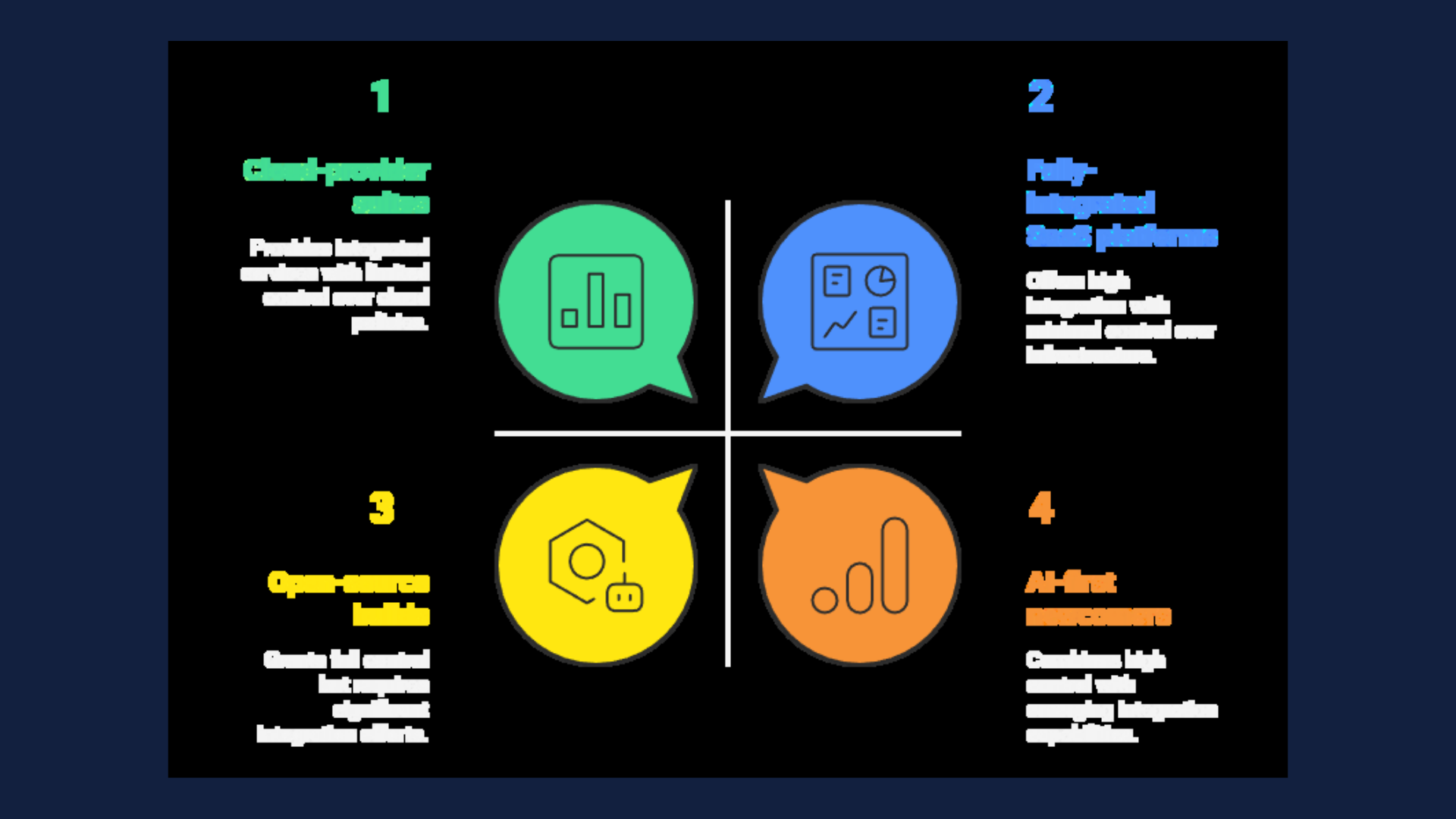
Below are the four most common ways to buy an observability platform, what each option actually is, popular examples, and a quick pros and cons snapshot to help you decide.
Fully-integrated SaaS platforms
A single vendor hosts the entire stack–collection agent, storage, dashboards, alerting and ML. You pay a subscription and log in to a web console.
Examples: Datadog, Dynatrace, New Relic, Splunk Observability Cloud.
Pros
Fastest time-to-value – agents, dashboards and SLO templates are turnkey
Deep cross-signal workflows (metric → trace → log) already wired
One invoice, one SLA; no infrastructure to size or patch
Cons
Per-host / per-GB pricing can spike at scale
Feature lock-in: advanced profiling or RUM often requires the proprietary agent
Data lives in the vendor’s tenancy unless you pay extra for “private” regions
Cloud-provider suites
Telemetry data lives inside the same hyperscaler that runs your workloads; you enable built-in collectors and view data in native consoles.
Examples: AWS CloudWatch + X-Ray, Azure Monitor + Application Insights, Google Cloud Operations Suite.
Pros
IAM, billing, encryption and region controls piggy-back on existing cloud policies
Zero egress costs when data never leaves the provider’s network
Good baseline metrics and traces without extra agents for managed services
Cons
Logs, metrics and traces sit in different UIs; correlation is manual or DIY
Limited support for multi-cloud or on-prem workloads
Advanced ML, SLO dashboards or cost controls often lag behind SaaS specialists
Open-source builds
You run and wire together community projects for collection, storage and visualisation: total freedom, total responsibility.
Examples: Prometheus + Grafana + Loki + Tempo, Elastic Observability, Jaeger, OpenSearch.
Pros
No licence fees; scale horizontally without vendor price jumps
Full control over retention, region and data schemas–ideal for strict compliance
Vibrant plugin ecosystem and no hard lock-in
Cons
Steep learning curve; upgrades and security patches are on you
Cross-signal correlation (logs, traces, metrics) requires extra glue code
Tiered storage and anomaly detection are add-ons, not defaults
AI-first newcomers
Cloud SaaS platforms built around high-cardinality analytics and ML from day one; often use OpenTelemetry under the hood.
Examples: Honeycomb, Lightstep, Grafana Cloud’s Pyroscope/Phlare.
Pros
Powerful “ask-anything” queries and heat-maps for complex systems
Click-through correlation is standard; traces carry million-cardinality tags without pain
Strong focus on developer workflow (CI/CD gates, feature-flag pivots)
Cons
Younger ecosystems – fewer native integrations with edge cases
Some features (e.g. custom ML detectors) still maturing or behind enterprise tiers
Pricing models vary (events vs. spans vs. datasets) and may be unfamiliar to finance teams
Business pay-offs
For many teams looking to invest in observability as a service, the benefits are obvious. However, it’s worth spelling them out for fence sitters.
Shorter incident bridges: correlated data lets on-call engineers resolve issues in minutes, minimising downtime. A big plus when you’re paying thousands a minute in lost revenue
Faster, safer releases: pipelines gate on live health signals, enabling daily deploys without midnight rollbacks
Lower cloud bills – clear views into resource utilisation reveal idle nodes and chatty loggers
Audit-ready evidence – long-retention traces answer “who, what, when” in one query
Better user experience – proactive issue detection prevents support tickets and churn
And if that doesn’t convince you, take a look at this recent study from New Relic, showing a twofold increase on observability ROI.
Still not convinced? Here’s how to run an pilot
Define success metrics – tighten SLIs for latency, error budgets and cost.
Pick two or three numbers that matter to your operations teams, then tell the cloud provider, SaaS vendor or MSP, “we pass the pilot if these targets hold.” Clear goals turn raw telemetry data into data-driven decisions.
To be clear – these numbers are NOT what you’re monitoring. They are key system performance KPIs for which you’re observability tools should catch the relevant telemetry data – whatever it may be – allowing you to make dial-moving decisions.

Map data sources – list hosts, containers, serverless functions and edge nodes
A quick inventory keeps scope small and predictable whether the observability platform lives in your own account, in an MSP’s VPC, or inside a native monitoring suite such as CloudWatch.
Deploy collectors – roll out OpenTelemetry agents with a minimal tag set; confirm real-time insights flow
DIY teams push the agents through CI/CD, cloud-suite users flip an “enhanced monitoring” toggle, and MSPs automate the same step for you. Either way you start getting real-time monitoring straight away.
Layer analytics and hooks – enable anomaly detection, dashboards and PagerDuty integrations
Activate proactive issue detection and route enriched alerts into PagerDuty, Opsgenie or ServiceNow. If you’re piloting with an MSP, they’ll wire these hooks and walk you through a simulated incident bridge.
Foster culture – review dashboards weekly, prune noisy alerts and feed learnings back into CI/CD for continuous improvement
Whether you own the tools or an MSP does, the pilot still needs engineers to meet, ask ‘Did we identify performance issues quickly?’ ‘Did we gain deep insights allowing us to move those numbers we picket at the outset?’
Delivery models – who owns the work?
Now we’ve explained how OaaS works, the benefits, and outlined a pilot scheme, it’s time to talk market options and delivery models.
DIY – all the knobs, all the responsibility
Running observability yourself keeps every lever inside your own walls. Your team rolls out the agents, sizes the databases or cloud buckets, patches collectors and answers the 3AM alert.
That level of control appeals when strict data-sovereignty or security rules demand in-VPC storage, or when an established SRE crew enjoys tuning open-source stacks and experimenting with custom dashboards.
The upside is absolute freedom: you decide retention periods, sampling rules and upgrade windows. The downside is effort. Night-shift rotas drain morale, upgrade projects steal sprint capacity, and plumbing hours can eat the licence savings you hoped to bank. DIY works best for organisations that already fund a 24/7 operations bench and value autonomy more than convenience.
DIY + vendor premium support – you drive, the vendor co-pilots
In this middle path you still operate the stack day-to-day, but you add a safety net from the tool maker.
A named technical account manager, short SLA ticket queues and quarterly tune-ups keep the product itself healthy and provide fast answers when agents misbehave or queries slow down. Mid-size teams like the arrangement because it offloads deep product troubleshooting without ceding architectural control.
The bargain, however, has limits. Premium support stops at the platform boundary. If the outage spans Kubernetes networking or another cloud service, you are still the first responder. And the uplift – often eight to ten percent of annual spend – buys advice, not on-call cover. Choose this model when you want expert guard-rails while staying firmly in the driver’s seat.
MSP-managed OaaS – a pit-crew for modern telemetry
Here you outsource the day-to-day grind to a managed-service provider. The MSP designs a universal tagging scheme, auto-deploys agents, keeps versions aligned and watches the single pane of glass around the clock.
When anomalies surface, the same team runs the incident bridge, correlates logs, metrics and traces, and escalates only when the fix lies in your code. Monthly cost reviews and quarterly SLO burn-downs show how they trimmed noisy logs, tuned sampling and met uptime targets.
The trade-off is reduced hands-on control. All changes flow through an agreed workflow, and success hinges on clear SLAs in the statement of work. Yet for scale-ups with thin SRE benches – or enterprises where every minute of downtime hurts revenue – an MSP converts observability into a predictable fee and delivers comprehensive visibility without a hiring spree.
How we can help
Whether you want to launch a pilot to gain insight on some key components of system health, or you’re ready to get started mapping out your entire product, we’re here to help.
We’ve turned telemetry into actionable insights for SaaS products, enterprises and SMEs around the world.
What’s more, we boast a trailblazing 24/7 service purpose-built for the world of distributed systems, and backed by our proprietary support product Mission Control.
We’re just as happy picking up existing monitoring tools or self-hosted observability platforms as housing you within our own tenant. So if you’re ready to start identifying bottlenecks, solving problems and delivering a better product, just get in touch.