






At Just After Midnight, we help businesses of all sizes to maximise the ROI of their cloud infrastructure.
We support, manage and build:
- Public cloud environments
- Virtual private cloud environments
- Multi-cloud environments
In this piece, we take a deeper look at our offering and explain the 2026 role of MSPs as well as the new drivers for both virtual private cloud and multi-cloud environments.
Our work with public cloud infrastructure: the broad role of the MSP in 2026
Cloud infrastructure management has changed. In the late teens and early twenty twenties, further abstraction was the growth model: serverless, increasing orchestration and furthering the sophistication of security and development with practices like DevSecOps.
For many teams, these services are still growth levers. The future of cloud is here. It’s just not evenly distributed.
That’s why we help partners by:
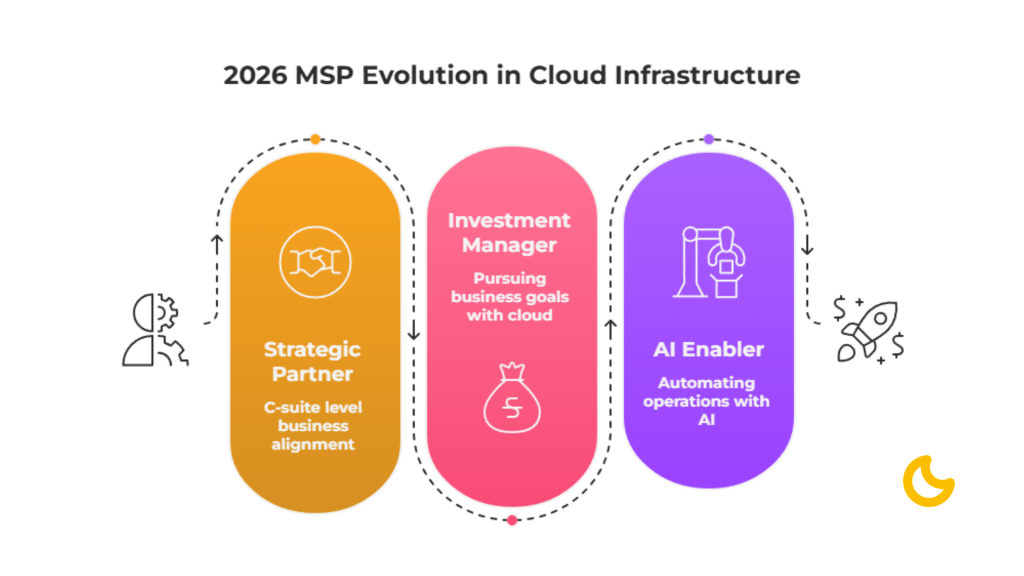
- Becoming strategic partners at the C-suite level
- Helping the teams we work with analyse their cloud spend and ROI
- Introducing AI into day-to-day operations
However, for more mature applications, cloud operations have changed again.
More visible in the boardroom; less visible in the environment
MSPs are making the transition from tech specialists to strategic business partners and AI enablers. A change driven by material realities. As technology stacks grow more determinant in business operations, bottom lines and growth strategies, so do MSPs.
That means, while our focus stays on application support, SRE and managed AWS, Azure and GCP, we’re approaching these services in different ways.
Outcome
Cloud infrastructure becomes easier to justify, govern and optimise at leadership level, with technical decisions more clearly tied to business performance, growth and risk reduction.
Strategic partners and managers of cloud investments
Where previous-gen MSPs solved tech problems, modern MSPs pursue business goals. This means translating C-suite-level objectives to cloud strategy. For example, moving from cloud cost monitoring to actively pursuing a margin movement on cost per serve: if a SaaS product charges X per seat, and the seat costs Y, targeted work undertaken shifts the margin.
Outcome
Cloud investment becomes commercially accountable, with optimisation work tied clearly to margin, product performance and growth objectives.
AI enablement and increasing ‘invisibility’
Good MSPs are appearing in fewer tickets. Humans are an invaluable resource when dealing with a complex incident or request. But they should not be the first line of defence. More efficient resource usage sees agentic responses taking centre stage.
For example, tickets from WhatsApp, Zendesk or email are sent to Amazon Bedrock. The AI then classifies the ticket, checks the knowledge base, and applies rules for handling or routing, escalating to a human agent if necessary.
Changes like this see MSPs like Just After Midnight as architects of AIOps, and, in some cases, less active day-to-day ‘doers’ in the cloud computing ecosystem.
Outcome
Support becomes faster, more scalable and less dependent on manual intervention, while human expertise is reserved for the incidents and requests that matter most.
Our work with multi-cloud infrastructure: the 2026 drivers
Multi-cloud environments are being driven by many of the same trends. Optimal infrastructures for AI, reliability and security. More precisely, when delivered correctly, multi-cloud allows customers to:
- Choose the right cloud platforms for costly AI workloads
- Ensure resilience in the case of (now not uncommon) provider-level outages
- Adapt to the tighter data sovereignty laws
How we build a multi-cloud for AI workloads
Workload portability is achieved through containerization and frequent checkpoint-restart cycles. Orchestrators monitor real-time GPU spot pricing, triggering migrations to optimise costs. By pre-positioning datasets in cross-cloud object storage, training runs are segmented into resumed time chunks. This means multiple clouds can function as the cheapest option for training and/or inference at any given time.
Outcome
Your AI workloads capture the lowest prices, best features and avoid GPU wait times.
How we engineer provider-outage level resilience
To overcome the vulnerability of public cloud resources to provider-level failures, we implement a multi-cloud strategy: building active-active environments running identical workloads, applying a global load balancer, and diverting traffic to whichever environment is operational. In this approach, a well-designed control plane ensures highly automated and consistent configurations.
Outcome
A best-case return on your resiliency ROI, reputation, and brand resilience in a world where competitors are impacted by provider-level outages.
How we use multi-cloud to enhance client compliance
Legislation like DORA and the EU Data Act increasingly require companies to have a viable data exit strategy, meaning reliance on one provider like Azure or AWS cloud is less viable for many. We work with clients to enhance portability, audit data, and build a compliant exit strategy for whichever legislation constrains them.
Outcome
Move into and operate in highly regulated, high-value sectors like fintech and healthcare; enhanced pitching and opportunities for government contracts.

Our work with virtual private cloud infrastructure: the 2026 drivers
Our work with virtual private clouds (VPC) is similar to our work with public cloud infrastructure; the ways MSPs provide value are changing here, too.
Traditionally, VPCs solved the security concerns of some early public cloud users by providing logical isolation, custom IP networking, and private subnets. Now, adoption of virtual private cloud infrastructure is being driven by three core business needs:
- Data leakage caused by wide-ranging LLM access
- Enhanced compliance requirements in line with EU and Asian data law
- Need for enhanced and secure lateral communication between microservices
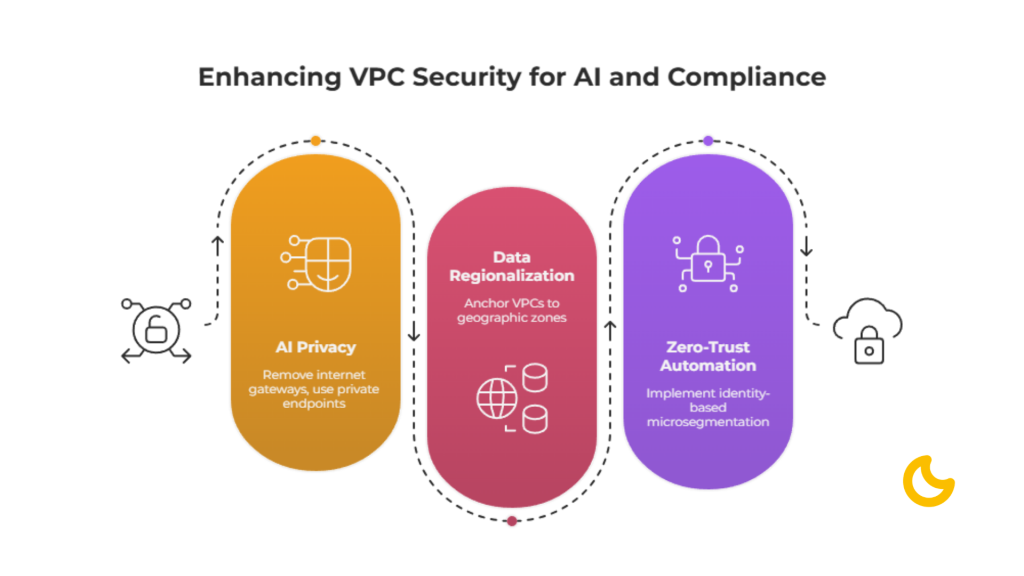
How we configure VPCs for AI privacy
As businesses expand AI use cases, controlling how models and tools access sensitive internal data is becoming a core infrastructure requirement. By removing internet gateways and using private endpoints, we hive off AI access to sensitive data. This leverages the VPC’s non-routable nature to ensure proprietary data stays on private fibre, reducing exposure to the public web.
Outcome
Sensitive data can be used in AI-enabled workflows with lower leakage risk and stronger privacy controls.
How we regionalise data flow for global compliance
By anchoring VPC service perimeters to specific geographic zones and implementing external key management, we enable global compute while keeping data locked to the region. What’s more, we tier our teams’ access. So, while our global support team might access flow logs and SRE metrics, only the teams based in the sovereign region will have database access.
Outcome
Global services remain possible without undermining data sovereignty, helping clients meet compliance demands while maintaining operational flexibility.
How we automate zero-trust for microservice sprawl
Microservices increase agility, but they also create more east-west traffic, more identities to manage, and more opportunities for lateral movement in the event of a breach. By replacing traditional IP-based firewall rules with identity-based microsegmentation, we ensure that every request between services is authenticated at the source.
This leverages the VPC’s ability to isolate individual workloads, containing any potential breach to a single container and preventing the lateral movement that traditionally leads to total system compromise.
Outcome
A more secure microservices architecture, with reduced blast radius, stronger service-to-service trust, and fewer opportunities for a local compromise to become a platform-wide incident.
How we can help
As a next-gen MSP, Just After Midnight is positioned to help our partners realise the value of their cloud investment. We do this by focusing on the challenges (and opportunities) that come with a quickly evolving technology.
Through both our cloud infrastructure consulting and cloud infrastructure support services, we deliver better business outcomes through better cloud services.
For our help on anything else, just get in touch.